


Wooden shelters in the garden: Which design suits which purpose?
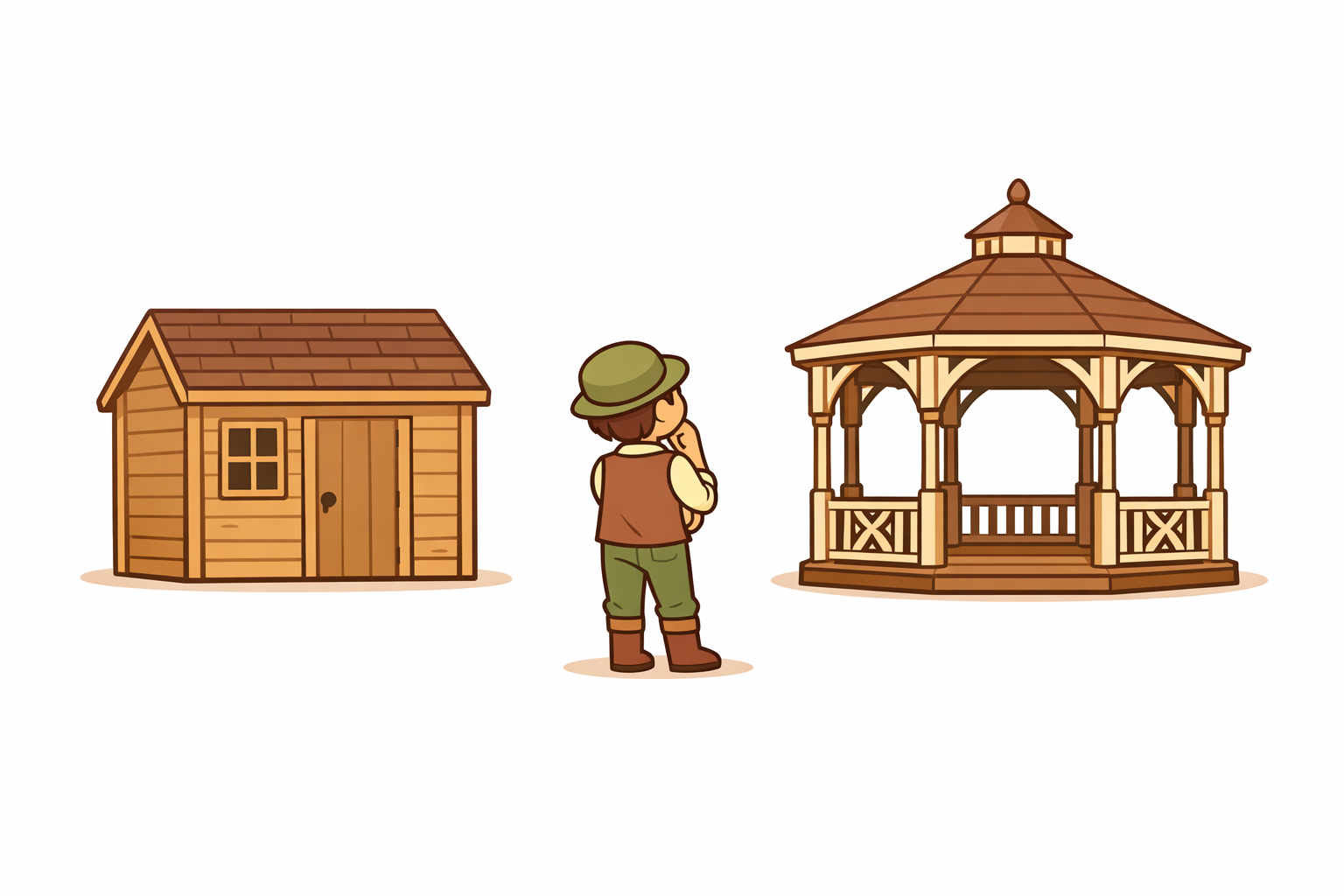
Bicycles, children's vehicles, garden tools, firewood - with every season, more material accumulates in the garden. Without a suitable shelter, the patio becomes a storage area, everything rusts more quickly and the garden looks cluttered. A carefully chosen wooden shelter keeps things tidy, protects against the weather and blends harmoniously into the overall picture. This guide shows you which type of structure is suitable for which purpose - with specific examples, Swiss framework conditions and clear decision-making aids.
Table of contents ▼
- Open wooden shelters are suitable for bicycles, children's vehicles and garden tools that need to be quickly accessible.
- Semi-open or closed structures are better for firewood, valuable machinery and windy locations.
- In Switzerland, snow load, boundary distances and foundations determine the safe and permissible design.
- Plan the contents first, then the size, type of wood and expandability - not the other way around.
The most important types of wooden shelters in the garden
Wooden shelters in the garden can be roughly divided into four types: open shelters, semi-open models with one or two walls, closed versions (almost like a small garden shed) and combined solutions with a storage area plus a seating or play area. Open shelters are ideal for frequently used bicycles, while closed designs protect sensitive equipment or wood better from the weather in the long term.
Swiss families are particularly interested in modular wooden shelters that can be extended at a later date - for example, if additional bikes, a moped or more firewood are added. Open constructions with a roof and few walls look light and fit well in small gardens, while closed boxes should be placed at the edge of the property or behind the house so as not to block the lines of sight in the garden.
Airy construction with a roof and a maximum of one rear wall. Ideal for bicycles, children's vehicles or garden tools that are in daily use. Quick access, good ventilation, but less protection against driving rain and snow.
With two to three walls or additional elements. Offers significantly better protection from wind and views, is suitable for firewood, machinery and as a weather-protected storage area. Looks more solid, requires a more careful choice of space.
A modular wooden shelter - such as those offered for bikes, motorcycles or garden tools - often combines both worlds: You start with a simple, open solution and add walls or another bay as required. In this way, the shelter grows with the needs of the family.
Purposes and suitable requirements
Which type of wooden shelter is suitable for which purpose depends directly on the contents, frequency of use and location in the garden. For bicycles and children's vehicles, an easily accessible, open shelter usually makes sense; for firewood, the focus is on stability and ventilation, and for expensive equipment, protection and lockability are the most important factors.
Bicycles, children's vehicles and scooters
For families with several bicycles, trailers and scooters, a wooden shelter with a roof and at least one rear wall has proven its worth. The vehicles stay dry, but are quickly accessible when it's time to go to school or work in the morning. In windy locations, two walls are useful to prevent rain from entering from the side. Make sure there is sufficient headroom so that taller people can also park and unpark comfortably.
Garden tools and machinery
Lawn mowers, scarifiers and high-pressure cleaners are sensitive to moisture. A semi-open to closed wooden shelter with two or three walls is worthwhile here. A door is not essential, but practical if children are playing in the garden and access to machines needs to be controlled. It is also important to have a stable, level floor - such as paving stones or a concrete foundation - so that equipment can be moved easily.
Firewood and stored goods
A wood shelter with a roof and a well-ventilated rear wall is ideal for firewood. The front can remain open as long as the shelter is not facing west with heavy driving rain. To ensure that the wood dries and does not start to rot, it needs space from the ground (e.g. on pallets or slatted frames) and air vents at the sides. For stocks over several winter seasons, you can roughly calculate 1.5 to 2 stere per year for a normal fireplace operation.
- Bicycles & children's vehicles: quick access, good lighting, non-slip floor.
- Motorcycles & scooters: higher access height, optional lockability, stable entry edge.
- Garden tools: dry, level floor, possibility for shelves or hook rails.
- Firewood: roof overhang, ventilation from all sides, distance from the ground.
- Garden furniture: sufficient depth for upright chairs, protection from UV radiation.
If you are looking for a solution that is as flexible as possible, choose a modular wooden shelter that you can initially use as a bicycle shelter and later add a compartment for firewood or garden tools. Such systems can usually be easily adapted to the existing garden structure.
How to choose the right wooden shelter for your garden
The right wooden shelter for your garden is created from the inside out: First you define the contents and use, then you determine the required area and only then do you decide on the type of construction, wood type and roof shape. In Switzerland, factors such as snow load, boundary distances and a suitable base are also important - a stable construction is particularly crucial at higher altitudes.
Count bicycles, equipment, amount of wood and consider what is used daily, weekly or only seasonally. From this, determine the accessibility, width, depth and necessary passage height.
Choose a location with good access without blocking important lines of sight. Check the boundary distances, solar radiation, wind direction and whether a frost-proof foundation or paving is possible.
Depending on your requirements, opt for open, semi-open or almost closed and choose between robust Douglas fir or impregnated spruce wood. Take local snow loads and expansion options into account.
For families who want to plan in stages, a modular wooden shelter, such as those available from specialist garden stores in the "Wooden shelter" category, is ideal. This allows you to adjust the depth and width relatively precisely without having to plan a complete custom solution. ([sanilu-garten.ch](https://sanilu-garten.ch/collections/holz-unterstand?utm_source=openai))
Plan a width of around 60 cm per bike plus space for movement and add at least 30-40 cm to the depth. This way, the wooden shelter will remain usable if a child's bike, trailer or a box for helmets is added later.
The following applies to the foundation: Simple point foundations or screw foundations are often sufficient for smaller shelters. In snowy regions or with larger spans, it is worth using a continuous concrete beam or slab covering to prevent subsidence. Many manufacturers specify minimum requirements for anchoring and snow load - you should take these seriously in the Swiss context, especially for free-standing structures.
Avoid common mistakes with wooden shelters
Many problems with wooden shelters are not caused by the construction itself, but by incorrect planning and use. Typical mistakes include insufficient space, lack of ventilation for firewood, inadequate anchoring or an unfavorable location directly on the property boundary without prior clarification with the municipality or neighbors.
Decision stage: Which solution suits whom?
An open wooden shelter makes sense if you and your children collect and return bicycles or toys several times a day. It is unsuitable if you live in an exposed location with strong winds and snow drifts or if you value privacy. In these cases, a semi-open system with two or three walls is more suitable - especially for expensive e-bikes or a motorcycle.
Closed shelters come into play if you want to combine machinery, upholstery, firewood and garden furniture or if you want the shelter to look like a small garden shed. They are well suited to larger properties and families who like to have everything "taken care of". Alternatively, you can also choose two smaller, thematically separate wooden shelters: one open for mobility and one better protected for stored goods.
In Switzerland, depending on the municipality, boundary distances, building height and roof shape are also regulated for wooden shelters. Before erecting, check briefly with the building authorities whether your project requires a permit or notification - especially for larger ones, high shelters or shelters built on the edge.
Another common mistake is neglecting wood care. Even weather-resistant wood benefits from constructive wood protection: sufficient roof overhang, distance from the ground, no standing moisture. Surface treatments with stain are often useful, but not necessarily necessary every year. It is important to detect damage at an early stage - such as cracks on load-bearing posts or loose anchoring after a winter with lots of snow.
Conclusion: How to make a safe choice
When choosing your wooden shelter in the garden, start with the contents and usage: how many bikes, how much wood, what equipment? Then decide on an easily accessible location with a suitable surface and check the local regulations. Finally, choose the type of construction - open, semi-open or closed - according to protection requirements and appearance. If you want to remain flexible, opt for modular systems that can be extended with additional bays or walls as space requirements grow.