


Planning garden paths: materials and costs
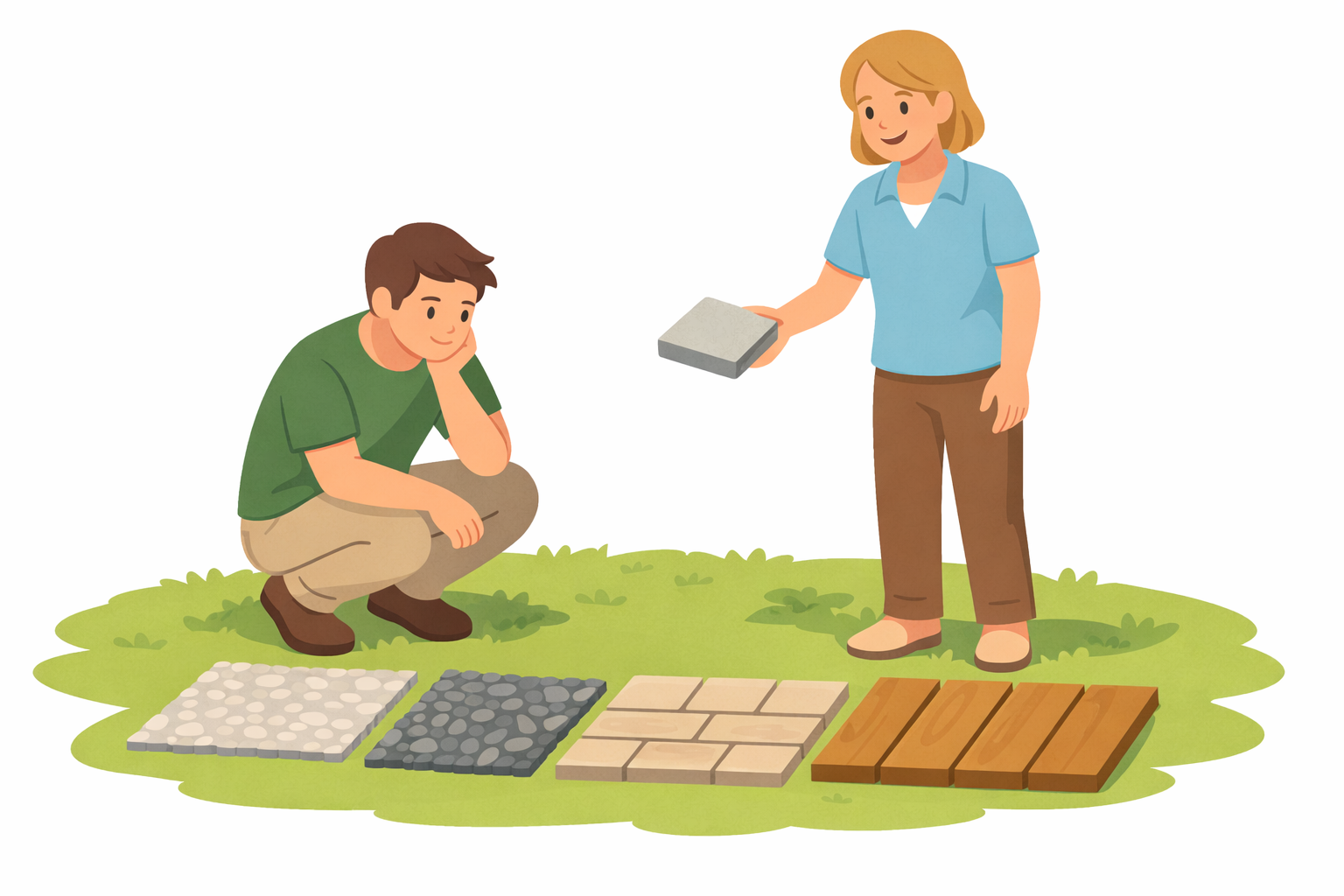
A garden path looks inconspicuous - until you trudge through the mud with wet shoes or children get stuck in the gravel on their scooters. Well-planned paths connect the seating area, play area, vegetable garden and entrance safely and conveniently. At the same time, they shape the atmosphere of the garden and influence maintenance requirements and costs for years to come. This guide shows you which materials make sense for Swiss family gardens, how to avoid typical mistakes and what budget you should realistically expect.
Table of contents ▼
- First plan garden paths according to function (main path, side path, children's path), then choose the material.
- Gravel, paving slabs and wood are inexpensive, but require more maintenance than paving or concrete.
- Roughly calculate with 80-250 CHF/m², depending on the material, substructure and personal contribution.
- Non-slip, low-barrier surfaces and well-drained paths are crucial for families.
Basics: Planning garden paths sensibly
A well-planned garden path follows the natural paths, can be walked on all year round and fits in visually with the house and garden design. Always start with the functions: What does the path need to withstand (children's vehicles, wheelbarrow, car access)? How often will it be used? And how important are appearance, accessibility and maintenance requirements for your family? Only then can you decide on the material, width, route and budget.
A clear hierarchy works well for families with children: a comfortable main path from the house entrance to the seating area, robust and non-slip, plus narrower side paths to the vegetable patch, play tower or compost. Curved lines often look more harmonious in the garden, but should not unnecessarily lengthen movements - especially when shopping or with a baby carriage. Plan slopes so that water can run off to the side and no puddles form in front of doors or on landings.
- Which paths are main paths and which are only used occasionally?
- Should the path be accessible for baby carriages, bicycles or wheelchairs?
- How strong is the sunlight and are there shady and damp areas?
- How much time do you want to invest in maintenance (weeds, leaves, snow clearing)?
- Which materials are visually suitable? to the façade, terrace and existing elements?
- What is your target budget per square meter - with or without personal contribution?
In family-friendly gardens in particular, it is worth thinking about paths and play areas together. For example, a paved path can also serve as a "race track" for scooters, while branching natural paths with stepping stones lead into a flower meadow.
Comparison of materials for garden paths
The most important materials for garden paths are gravel, paving stones, concrete slabs, water-bound surfaces and wooden or honeycomb solutions. Gravel and paving slabs are inexpensive and flexible, but less barrier-free. Concrete slabs and paving are more expensive, but durable, easy to clean and safe to walk on. In addition to cost, feel, appearance, maintenance and drainage also play a decisive role in the choice.
Below you will find a practical overview of the most common materials for Swiss family gardens - with typical properties, areas of application and a rough cost framework. The information is intended as a guide and can vary significantly depending on the region, substrate, accessibility and product selected.
Inexpensive, quick to install and visually versatile. Ideal for side paths and ornamental paths. Disadvantage: Prams and scooters are difficult to maneuver, stones quickly land on the lawn and regular refilling and weed control are necessary. Slipping must be prevented on slopes.
Paving stones or concrete/natural stone slabs provide a stable surface that is easy to walk on. They are ideal for main paths, seating areas and driveways. They require more material and work, but are durable, easy to clear in winter and much more family-friendly if laid neatly and chosen to be slip-resistant.
Water-bound surfaces (bound gravel) create a firm but water-permeable surface - pleasant to walk on, but sensitive to constant rain or heavy use. Wooden walkways or stepping stones have a warm and natural look, but require high-quality, weather-resistant wood and regular checks for slipping and splinters.
Combine materials in a targeted manner: e.g. a robust flagstone path as the "main route" as well as cheaper gravel or stepping stone paths to less frequently used areas. This keeps the budget in check without sacrificing comfort and safety.
If you are also interested in child-friendly garden design with play equipment, it is worth taking a look at the suitable solutions in the collection for all garden play equipment at Sanilu Garten.
Realistically estimating the cost of garden paths in Switzerland
For most families, the question of cost is central. The total cost of garden paths is made up of excavation, base course, edging, surfacing material and labor. As a rough guide, you can expect to pay CHF 80-250/m² for professionally constructed paths - depending on whether you do a lot of the work yourself, choose inexpensive materials and how demanding the substrate is.
Gravel paths with a simple base layer are generally the cheapest, especially if you can do the excavation and installation yourself. Paving or slabs are in the middle range, but offer significantly more comfort and durability. Elaborate solutions with natural stone or sophisticated drainage (e.g. for slopes) are in the upper range or significantly higher.
Measure the planned path areas and make a clear distinction between main paths, side paths and possibly a driveway. Determine which sections need to be particularly robust and barrier-free and where you can work with simpler surfaces.
Define a rough maximum amount and allocate it to the individual path types. Allow a safety margin of 10-20% for unforeseen additional work, such as difficult surfaces or additional edging.
Think about what work you can do yourself: Excavation, spreading gravel, removing turf. Precision work such as placing kerbstones or slabs on a bed of gravel is often best left to a specialist company to avoid subsequent subsidence.
Obtain at least two quotes for challenging sections and pay attention to the scope of services: substructure, drainage, material quality, disposal of excavated material. This will show you whether the price comparison is fair and where savings can be made without compromising on quality.
Remember that a solid substructure is the real "cost block" - and at the same time determines whether the path will give you pleasure for 5 or 25 years. Cutting corners at this point often leads to subsidence, puddles and repair work that becomes more expensive later on.
How do you choose the right material?
For families, the right choice of material is a consideration of safety, suitability for everyday use, appearance and budget. Robust paved surfaces make sense for main paths, entrances and rolling surfaces for children's vehicles; cheaper, less stable materials are more suitable for decorative or rarely used paths. The more a path is used and loaded, the more worthwhile a high-quality, low-maintenance surface with a good substructure is.
A combination often makes sense: concrete slabs or paving for access to the house, patio and play area, plus gravel paths or stepping stones in the perennial or vegetable garden. Pure gravel paths are unsuitable if baby carriages, wheelchairs or bicycles are regularly used - frustration is inevitable. Wooden walkways look charming in natural gardens, but are prone to slipping in damp and shady areas and require more maintenance.
Which garden path is suitable for whom?
For families with small children and frequent visitors, non-slip, hard surfaces are usually the best choice: they are easy to clean (mud, sand, food), provide stability for balance bikes and can be cleared in winter. If you place particular value on being close to nature and have little cycle traffic, you can create attractive, unobtrusive solutions with water-bound surfaces or gravel paths. On slopes and in loamy soils, it is particularly important to have a seepage-friendly but stable structure with adequate drainage.
Slippery surfaces (smooth natural stone, wood without grooves) and a lack of drainage are frequent sources of accidents, especially with children. If in doubt, test sample pieces in wet conditions and plan a minimal crossfall so that water drains off and no icy patches form.
If you are unsure, first create a provisional path with boards or lawn edging stones and test it for a few weeks in everyday life. This will quickly show you whether the width and lines really work for your family.
Common planning errors with garden paths and how to avoid them
Many problems with garden paths are not caused by the material itself, but by planning and execution errors. Typical problems include paths that are too narrow, a lack of or inadequate substructure, insufficient slope or unsuitable surfacing in high-traffic areas. With a little foresight, these stumbling blocks can be easily avoided.
One of the most common mistakes is to make the path too narrow: 60 cm is enough for a narrow garden path, but is difficult for two people or a baby carriage. For main paths, a width of 90-120 cm is much more suitable for everyday use. The substructure is also underestimated - especially on natural, loamy soil. If you use too little gravel or the wrong material, you risk subsidence and waterlogging.
Typical mistakes at a glance
- Too little substructure: The path sags, slabs tip over and puddles form.
- Wrong surface in the wrong place: gravel in front of the front door, wood in permanently damp shady areas.
- Lack of slope: Water collects, patches of ice form in winter.
- Impractical widths: Paths are too narrow for children's vehicles or garden tools.
- No clear path layout: children run across flower beds, lawns are trampled.
Plan paths consistently based on their use: How do children move around, where do bicycles ride, where do you put garbage containers? If these questions are answered honestly, the error rate will be significantly reduced - and the garden will function noticeably better in everyday life.
Conclusion: How to proceed now
Start with a simple plan of your garden and draw in all the daily paths - from the letterbox to the play tower. Determine which sections must be absolutely comfortable and barrier-free and where a natural, inexpensive surface will suffice. Obtain quotes for challenging areas, opt for a deliberate combination of materials and invest consistently in a solid substructure. In this way, you can create garden paths that are practical for your family today and will still work in ten years' time.